Press
Canadian painter Matt Crookshank isn't afraid to fail. In fact, his no-holds-barred, confrontational approach is what results in the wild hits and misses that make his abstracts so bold and unusual.
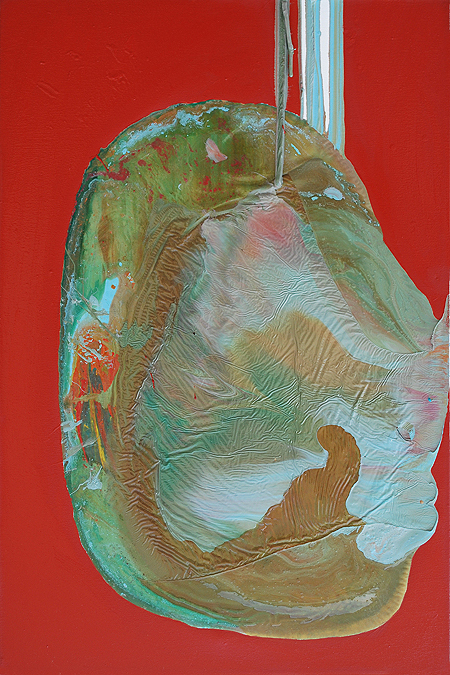
Crookshank's large and small canvases are full of conflicting elements, even on the material level. Works in this solo show, The Unlikely Event, contrast thick impasto smears with shallow areas of poured resin.
Some materials chemically rebel against the surrounding paint, causing areas of seething geologic upheaval on the surface. In others, geometric lines and colours borrowed from digital technology clash with earthier tones and explosions of primary colours.
They often bring to mind cosmic creation and upheaval, the birth and death of stars, galaxies and planets.
While many of his marks could be called gestural, Crookshank is also invested in the accretion of paint on canvas. Endless Painting, for instance, came about after he'd abandoned it, using it as the place to dump the residue of other paintings in progress.
"I hated it," he admitted recently, "and had given up on it entirely. Then one day it came alive and I started to work on it again. Now I realize that hating a painting is a vital part of putting me on the road to a successful work."The show highlights his older work as well as his most recent. The front of the gallery features two brand new paintings that veer away from his earlier sculptural layering and opt instead for a flatter but no less electric accumulation of warring visual layers.
They represent a new direction for a painter who wants to surprise himself, fusing an organic sensibility and faith in his process with a broad and confident visual vocabulary.
Unlike his optimistic colleague, painter Matt Crookshank created his show Eternal Flame: Ten Large Painting For World Peace out of a growing sense of frustration with the dialogue, around peace and peacemaking.
"I've been pretty depressed and distracted lately by world politics, so I started to crawl into my own drawings and I noticed there were all these conflicting tendencies – harsh lines and marks mixed with fluid, organic shapes. It looks like a war to me. So I put my conflicting impulses on the canvas to see if they could come to some sort of an agreement."
The resulting works are, to say the least, contradictory. Transparent washes of dreamy colour barely cover violent, aggressive graphics that look like explosions. The paintings have an intentionally unfinished, hesitant to look and convey more anxiety than serenity.
"Yeah, well, they're my internal war, made external," Crookshank adds. "Like a lot of people, I feel extremely helpless and frustrated, as if whatever happens is totally out of my hands. No matter what anybody says or paint or performs, we're having a war with Iraq because the Americans want one. And the very idea of peace seems like a remarkably dated idea – you say "peace" and your instantly back in the hotel bed with John and Yoko. And everyone treats you like a simpleton. The really important concept becomes irrelevant because of sentimental nostalgia." Crookshank, laughs uneasily. "Paintings are as likely to make peace as UN negotiations. I guess I just want to see if I could get the word peace printed in the newspapers for a change."
More Press
- 2013 Summer Shows at General Hardware, Akimbo, Terence Dick, July 16
- 2013 Festival Preview: No Rhyme or Reason, The Edmonton Journal, Fish Griwkowsky, June 19
- 2012 Canvas Conflict, NOW Magazine Review of The Unlikely Event, David Jager, Nov 29
- 2012 Matt Crookshank at General Hardware, Review, Akimbo, Terence Dick, Nov 27
- 2012 The Unlikely Event Review, Toronto Is Awesome, Kate Morris, Nov 21
- 2012 Interview: Matt Crookshank, Art Sync, Nov 172012 Hit List, Akimbo, May 17
- 2008 Jones, Chloe. “Dual Reality“ Where Magazine, May/June Edition
- 2008 Saad, Shirine. “The Art of Buying“ Fashion Magazine, April Edition
- 2008 Upcoming Exhibitions, Western Canada, Canadian Art, Spring Edition
- 2007 Rogers, Damian. “Toxic Avenger“ Eye Weekly, Oct 42007 Forsey, Richelle. “Matt Crookshank at LE Gallery“ BlogTO, Oct 7
- 2006 Reynolds, Travis. “A Tale of Two Hemispheres” The Calgary Harold/Swerve Magazine; May 2
- 2005 Vaughan, RM. “FourM Review” The National Post; March 5
- 2004 Doherty, Mike. “Leather Rebels Provide the Muse” The Globe and Mail; July 12
- 2004 McLean, Clint. “Under There” [Photo essay] Hive Magazine; Issue4
- 2003 Hirschman, Thomas. “Autumn Action” NOW Magazine; September 4
- 2003 McConvey, Joel. “Live Work, breathing optional” Eye Weekly; June 26
- 2002 Vaughan, RM. “The Peace Stars” (Eternal Flame review) The Globe and Mail; October 3,
- 2002 Goddard, Peter. “A Show of Cheek from the City’s East End” Toronto Star; August 29
- 2001 McKay, Sally. “The Future” Lola Magazine; Summer Edition
- 1999 Kim, Anne. “Geometrick” Lola Magazine; Summer Edition
- 1999 Niedzviecki, Hal. “Charm” Broken Pencil Magazine; Winter Edition